Solar mounting systems form the structural foundation of a photovoltaic system, serving to secure the panels, withstand wind and snow loads, and facilitate heat dissipation and earthing. Choosing the wrong mounting system can lead to water ingress, reduced power output and even safety hazards, directly affecting the system’s 25-year service life.
Solar Mounting Systems: The Unsung Heroes More Important Than the Panels
If you ask an American what the most important part of a solar system is, nine times out of ten they’ll say ‘the solar panels’. That’s only natural—the panels are large, shiny and high-tech, and sitting on the roof, they’re plain for all to see. But those who really know their stuff will tell you: the solar mounting system is the backbone of the entire setup. Without them, those expensive panels would be nothing more than a pile of glass waiting to be shattered by Texas hailstones or blown away by Florida hurricanes. Put simply, solar mounting systems are the metal structures that secure photovoltaic panels to roofs, the ground or carports. But this isn’t something you can sort out with a few off-the-shelf screws. In the US, you have to contend with hail in Oklahoma, snow loads in Upstate New York, earthquakes in California, and the tropical storms that arrive punctually every year along the Gulf Coast. For this very reason, mounting systems in the US are not ‘off-the-shelf components’, but aluminium alloy or galvanised steel structures designed strictly to engineering standards. Not only must they withstand wind, snow and corrosion, but they must also provide ventilation gaps for the panels – for every degree the temperature of a solar panel rises, its power generation efficiency drops by one per cent. At the same time, the mounting system must ensure proper earthing for the entire array; otherwise, during a thunderstorm, your inverter could be reduced to a pile of scrap metal. It is fair to say that a good mounting system is the deciding factor between a solar system lasting 25 years or just 5.
In the US residential market, the most common type is the flush-mount system. The principle is straightforward: the installer locates the roof rafters, secures the rails using long bolts fitted with waterproof caps, and then clips the solar panels onto the rails. The entire system protrudes only three to five inches above the roof tiles, appearing as if it were an original feature. However, the challenge lies in building codes. Requirements regarding roof load-bearing capacity, fire safety clearances and wind resistance vary significantly from state to state. For example, in Miami-Dade County, Florida, mounting systems must withstand winds of up to 170 miles per hour, and the pull-out strength of every bolt must be tested on-site. In Colorado, however, snow load is the primary concern—mounting brackets must be spaced much closer together, otherwise the panels could slide off en masse once the snow melts in spring. If the roof is made of asphalt shingles, the standard practice is to drill holes directly into the surface; but what if your home has clay tiles, slate tiles or a standing seam metal roof? In that case, bolts cannot be used. Standing-seam metal roofs have specialised clamp-style brackets that grip the raised seams of the roof, securing the array firmly without drilling a single hole. For flat-roofed commercial buildings (such as Walmart or apartment blocks), there are ballast-type brackets: these do not penetrate the roof, but rely on concrete blocks to weigh down the entire array, using the weight to counteract wind uplift. The advantages are speed and watertightness; the disadvantage is that you must ensure the roof structure can withstand the extra weight of over ten pounds per square foot.
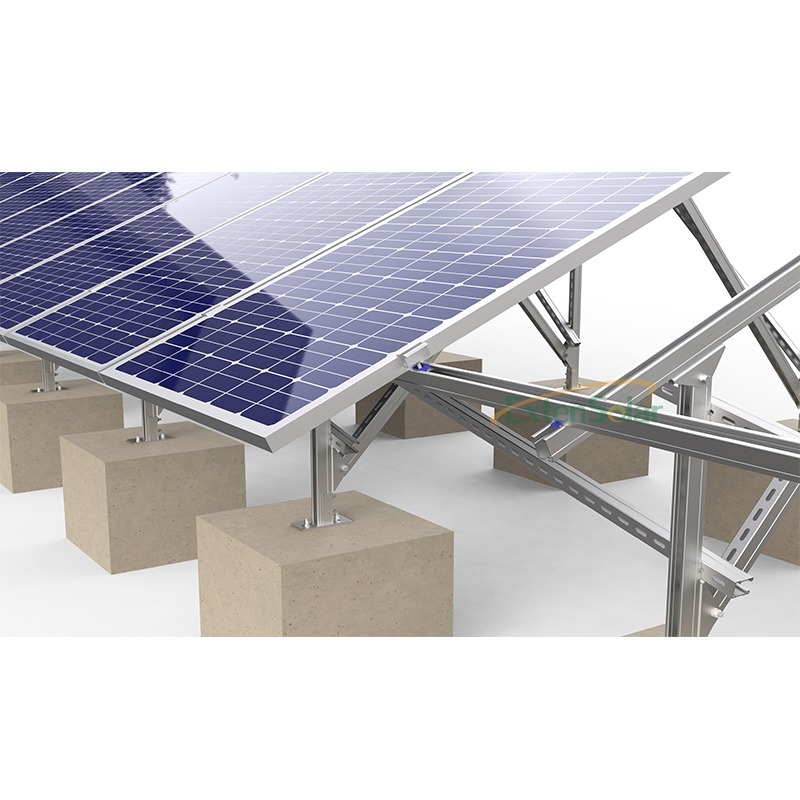
But what if the roof conditions aren’t ideal? For instance, if there isn’t enough south-facing roof area, or if the rafters on an older building can’t withstand the strain? That’s when ground-mounted racks come into play. Ground-mounted racks are straightforward: dig a pit, pour a concrete foundation, erect steel columns, lay crossbeams, and finally install the panels. Their greatest advantage is the adjustable angle – in Atlanta, you tilt the panels at 30 degrees; in Minneapolis, 40 degrees. On a roof, you’re limited to the roof’s slope, which is often not the optimal angle. Furthermore, ground-mounted systems require no ladder for maintenance; hosing down the panels or replacing an inverter is far more convenient. Of course, the trade-off is higher costs: trenching for cables, concrete foundations and more steel mean the total cost is 15–20% higher than a rooftop system. But if you live in the countryside, on a farm or have a plot of open land, it’s money well spent. A more advanced option is a single-axis tracking system—where an entire row of panels rotates from east to west like sunflowers, generating 20–30% more electricity over the course of a day. Those slowly rotating blue arrays you see at solar farms in California’s Central Valley or West Texas are exactly that. For the average household, single-axis trackers require a large open space and are more complex to maintain; it’s usually not as cost-effective as using that money to buy a few extra fixed panels and a battery bank instead.
Finally, a word of honest advice for US homeowners about to sign a contract: don’t just look at the brand of the solar panels; make sure you ask about the mounting system’s specifications. You need to confirm at least three things. Firstly, does the mounting system have UL 2703 certification? This is Underwriters Laboratories’ standard for the structural strength, grounding performance and fire resistance of solar mounting systems. Without this certification, local inspectors won’t issue you a grid connection permit. Second, are the mounting system’s wind and snow load ratings suitable for your county? A system rated for 110 mph winds simply won’t pass inspection in Virginia Beach or the Florida Panhandle. The installer should perform on-site load calculations, rather than just guessing and telling you ‘it should be fine’. Thirdly, do the mounting systems match your roof type and the dimensions of your solar panels? Some cheap systems use a shared rail design, meaning that if you want to replace a single panel later on, you’ll have to dismantle half a row. Good systems (such as IronRidge, Unirac and QuickBolt, which are common brands in the US market) use independent clips, so removing or installing a single panel does not affect the adjacent ones. Finally, make sure you clarify the warranty. High-quality aluminium alloy mounts won’t rust for 25 years, but cheap painted steel will start to corrode within three to five years in the humid climate of the South-East or the salt-air environment of Hawaii. Don’t forget that the US federal solar tax credit (ITC) currently covers 30% of the total system cost – and that 30% includes the mounting system. So don’t risk thousands in repairs just to save a few hundred on the mounts. After all, the last thing you want to see after a thunderstorm is your expensive panels scattered all over your neighbour’s lawn. Solar mounting systems aren’t sexy or flashy, but they are the silent foundation that gives you peace of mind as you recoup your electricity costs over 25 years. Choose the right one, and it’s nothing special; choose the wrong one, and it’s the price you pay for the whole project.


