When fixing solar panels to flat roofs, a vital question always emerges: whether to drill holes or not. For numerous building owners, drilling holes on the roof is rather a big inconvenience.
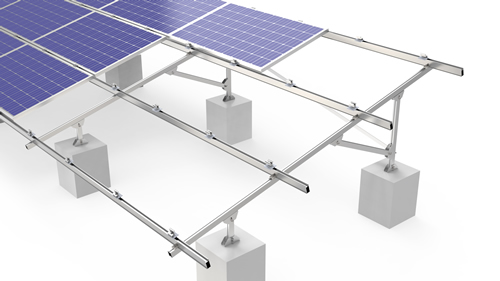
They are concerned about damaging the waterproof layer, affecting the roof structure, and - most significantly - being worried that if there is a leakage later, it will be very hard to repair.Actually, there is a proven method that can completely avoid these concerns, namely the installation system that is based on ballasts.The core concept of this system is quite simple: it depends on weight to keep stability rather than penetrating the roof for anchoring.
This system does not need to go into the roof structure. Instead, the concrete ballasts are directly placed on the installation bracket bases, and depending on their own weights to resist the wind uplift force, the entire photovoltaic array is kept firmly on the roof.According to the search results this method is particularly common on flexible membrane roofs such as ethylene propylene diene monomer rubber (EPDM) thermoplastic polyolefin (TPO) and polyvinyl chloride (PVC) because drilling holes in the waterproof membrane will greatly increase the risk of water leakage and may even make the roof warranty invalid.From this perspective the ballast system's greatest value lies in the maintenance of the roof's integrity and its original waterproof performance.
In terms of technical specifications the ballast system is quite flexible the inclination angle which can usually be adjusted according to project requirements and is generally between 0 and 60 degrees can make the system adapt to the different sunlight conditions in various regions.The module can be arranged either in a horizontal manner or in a vertical manner, and this depends on the shape of the roof as well as the requirement of the installation capacity.Regarding the material, the installation frame, which is generally made of high-strength AL6005 - T5 aluminium alloy along with stainless steel fasteners, guarantees the structural strength and also the long - term corrosion resistance.
One of the most common concerns is how much wind the ballast system can withstand. The search results indicate that a well - designed ballast system can bear wind speeds up to 60 meters per second which is approximately equal to a level 14 typhoon. Of course, such wind resistance is not simply obtained by piling up weight but is rather achieved by finding a balance between the load - bearing ability of the roof and wind safety through scientific calculations.When carrying out wind load calculations, engineers are demanded to comply with standards like ASCE 7. The height of the building, the position of the roof (whether it is in a corner, an edge or a middle area, etc.) and the surrounding terrain need to be considered, because wind pressure demands vary significantly due to specific locations.
Regarding the aspect of the roof's load - bearing capacity, the ballast system also has obvious advantages. The advanced design, by optimizing the structural layout, reduces the overall weight so that the load is within the range of the roof's load - bearing capacity. Search results show that some systems featuring a matrix - like arrangement and a wind - shield design can effectively cut down the ballast weight per unit area, thereby minimizing the load on the roof structure and at the same time ensuring stability. Additionally, in order to adapt to the large - scale photovoltaic modules that are popular in the current market, some systems create installation points on the long sides of the modules which are used to disperse the weight and prevent the situation of sagging or deformation at the center of the modules.
Regarding installation, the system that is based on ballasts is also relatively simple. A large number of products that have installation brackets have already been highly pre - assembled in factories, and only simple on - site assembly is needed to finish the installation.The placement of ballast blocks has to be strictly in line with the engineering design drawings; the quantity of ballast blocks needed differs according to the area (like the roof edge and the middle part), thus the installation cannot be carried out with a "haphazard estimate" mind - set.After the installation is finished all connections need to be carefully examined to make sure they are firmly fixed and the ballast should be placed in the right position then the venue has to be cleaned to guarantee that the roof drainage system is not obstructed.
Finally, one should pay attention to the inclination angle, which is often an overlooked design point, when fixing solar panels to flat roofs. A lot of people think that because it is a flat roof, the panels can be placed directly flat.However, in fact, even on a flat roof, it is still advisable to maintain an inclination angle of at least 5 to 10 degrees.This angle is not casually determined - it can ensure that rainwater is smoothly drained, prevent the accumulation of dust that may reduce power generation efficiency, and also enable the solar panel to be self - cleaning to a certain extent. So, "flat roof" is not the same as "installed flat", and such a difference needs to be clarified during the design phase.
Generally speaking the system installed on the ballast offers a solution for flat - roof solar projects that can balance the aspects of safety and feasibility it without drilling or penetrating walls has solved the waterproof and structural issues that most homeowners are concerned about.Through scientifically chosen design, strict structural calculations and appropriate on-site installation, this system that has a service life of up to 25 years can be operated reliably.For professionals who are evaluating flat - roof photovoltaic projects, this solution that is well worthy of being carefully studied and considered is indeed such.


